
Feature landing pages
Ask Questions About Your Books
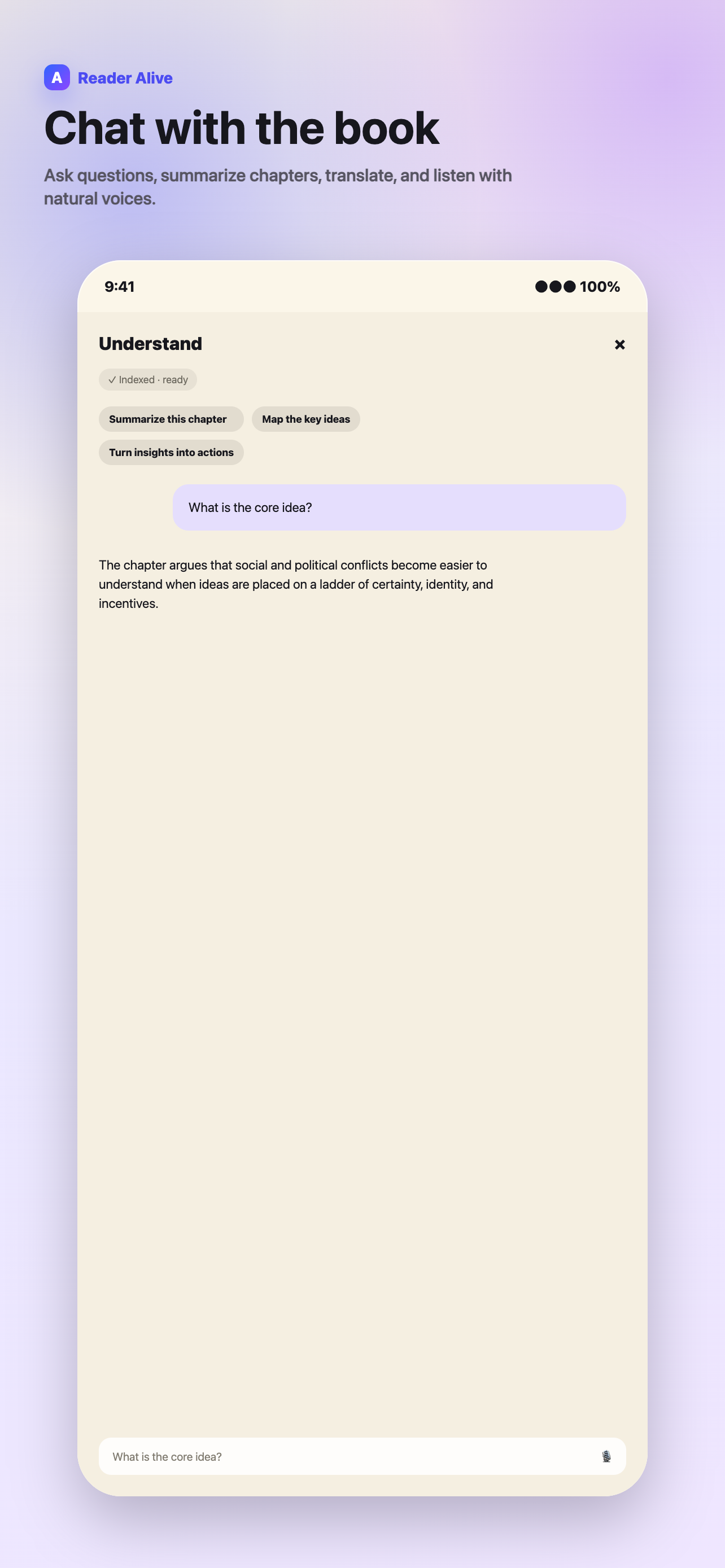
Use book-aware chat to clarify a passage, test your understanding or turn a chapter into something you can act on.
Who this is for
This page is for readers who want AI help that stays close to the book instead of generic answers detached from the text.
Product video
Watch the workflow
This short product video uses the real Reader Alive app recording with a lightweight original background track for a smoother viewing experience.
Product views
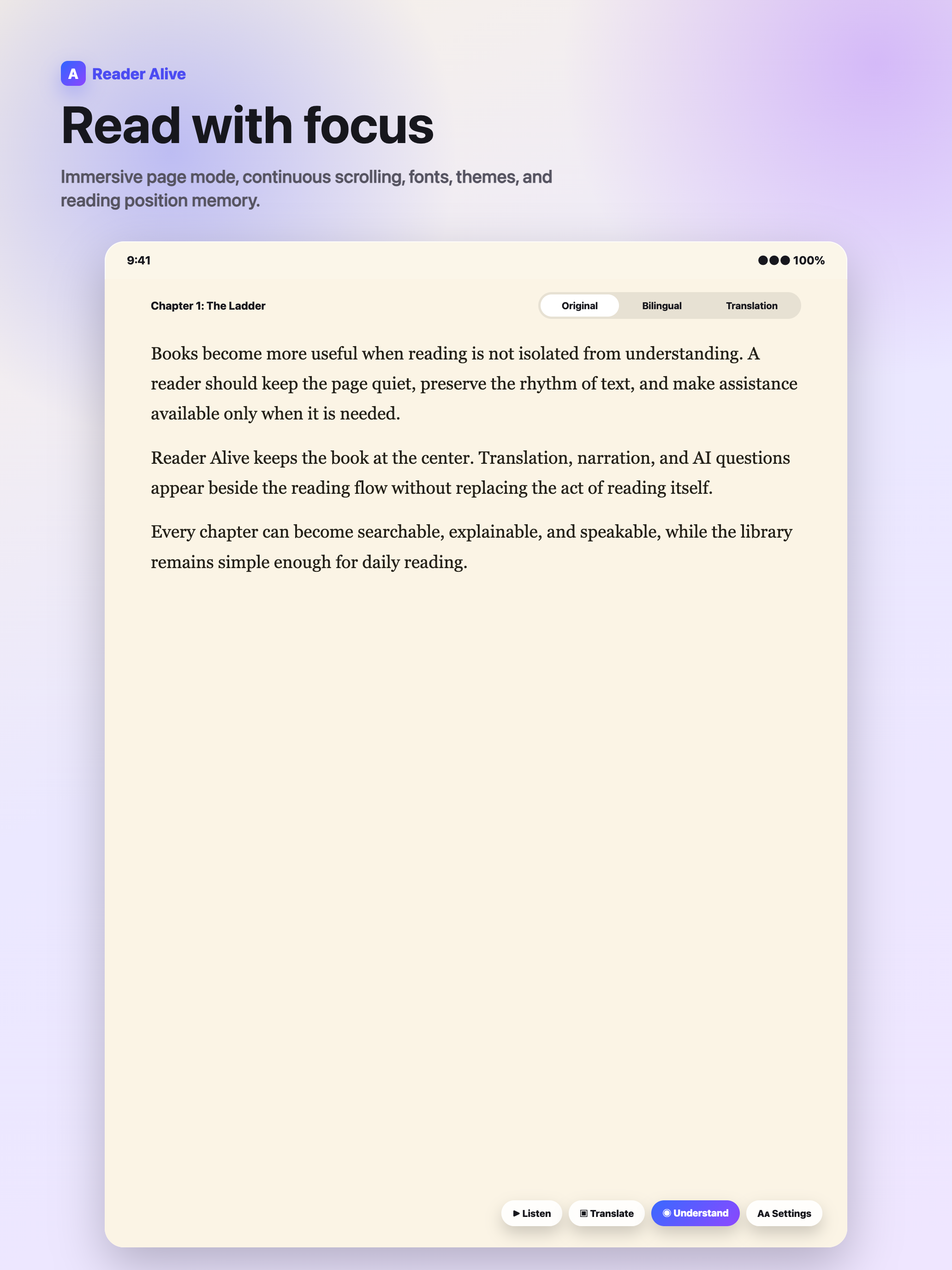
These views show how the feature fits into Reader Alive's real reading flow.
How to use it
-
Start from a passage
Select or open the section you want to understand before asking a question.
-
Ask a concrete question
Ask what a passage means, what the main claim is or how ideas connect.
-
Request structured outputs
Use summaries, timelines, key ideas or action lists when they help you reread.
-
Verify against the book
Treat AI answers as a guide back to the source text.
The best book chat starts with the text
A useful reading assistant should answer questions about the text you are reading, not pull the conversation away from the book. Reader Alive is designed around book-aware questions that use selected text or relevant context.
That makes it useful for dense nonfiction, technical material, history, philosophy, language learning and any chapter where you want a second pass.
Questions that work well
Ask what a passage means, what assumptions the author is making, how a section connects to an earlier idea or what terms you should understand before continuing.
You can also ask for summaries, timelines, action lists or key ideas. These outputs are most helpful when treated as reading aids, not as substitutes for the book.
Control and privacy
Book-aware chat is optional. When you explicitly ask a question, selected text, relevant excerpts or your question may be sent to an AI service provider to generate the answer.
Reader Alive keeps this separate from ordinary reading. Opening a book is not the same thing as asking AI to process it.
How this fits into Reader Alive
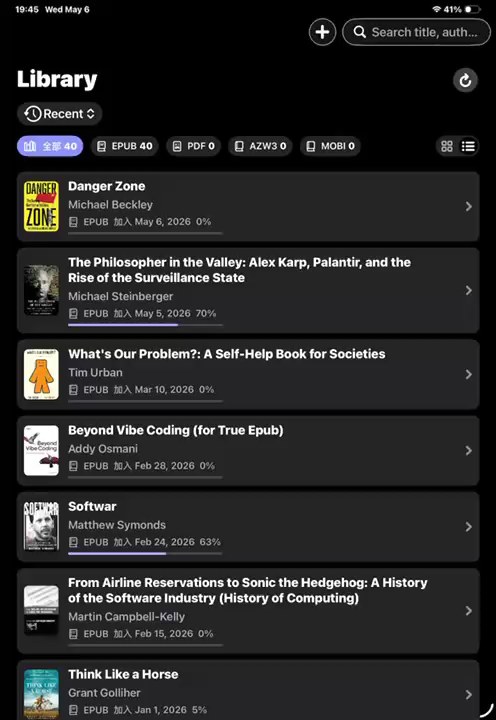
Reader Alive is not only a ask questions about your books. It is a reading environment for people who keep personal ebook files and want the same library to handle EPUB, PDF, MOBI and AZW3. That matters because real reading collections are rarely clean. A reader may have public-domain EPUBs, PDF course packets, older MOBI files, exported AZW3 books and research material saved from several devices.
The best way to evaluate the app is to import a few representative books rather than a perfect sample. Try one long EPUB, one PDF, one older file and one book in another language. That gives you a realistic sense of typography, navigation, AI assistance and whether iCloud continuity fits the way you move between iPhone and iPad.
Limits and honest expectations
There are also limits worth stating clearly. Reader Alive is intended for books and documents you can legally import and open. DRM-protected files may not work in third-party readers. Scanned or image-only PDFs can limit text-to-speech, summaries and book-aware questions because those features depend on usable text.
AI features are explicit actions. When you use translation, text-to-speech, summaries, voice input or book-aware chat, selected text, relevant excerpts, audio input or your question may be sent to AI service providers to complete that request. Ordinary reading and file storage are separate from choosing to use an AI feature.
For high-stakes reading, treat AI output as a map back to the text rather than the final answer. Summaries, timelines and explanations are useful because they help you reread more effectively, not because they remove the need to check the source.
What to check before choosing
Grounding
Answers should stay tied to the book, not drift into generic web-style responses.
Reader control
Chat should run when you ask for it, not automatically process every book.
Best fit
Useful for dense nonfiction, study material, language learning, timelines and confusing passages.
Ask questions such as
- What is the main argument here?
- Explain this passage in simpler language
- Make a timeline from this chapter
- What should I remember before continuing?
FAQ
Can I chat with an EPUB book?
You can ask book-aware questions about supported text when you explicitly use AI chat.
Is book chat useful for fiction?
It can be useful for character relationships, timelines, themes and confusing passages.
Does Reader Alive process the whole book automatically?
No. AI requests happen when you explicitly use AI features such as chat, translation or summaries.
Reader Alive for iOS
Ask better questions about the book you are already reading.
Use Reader Alive book chat to clarify passages, summarize chapters and turn long reading into usable understanding.